The police stopped me on the street. What should I do, and what are my obligations?
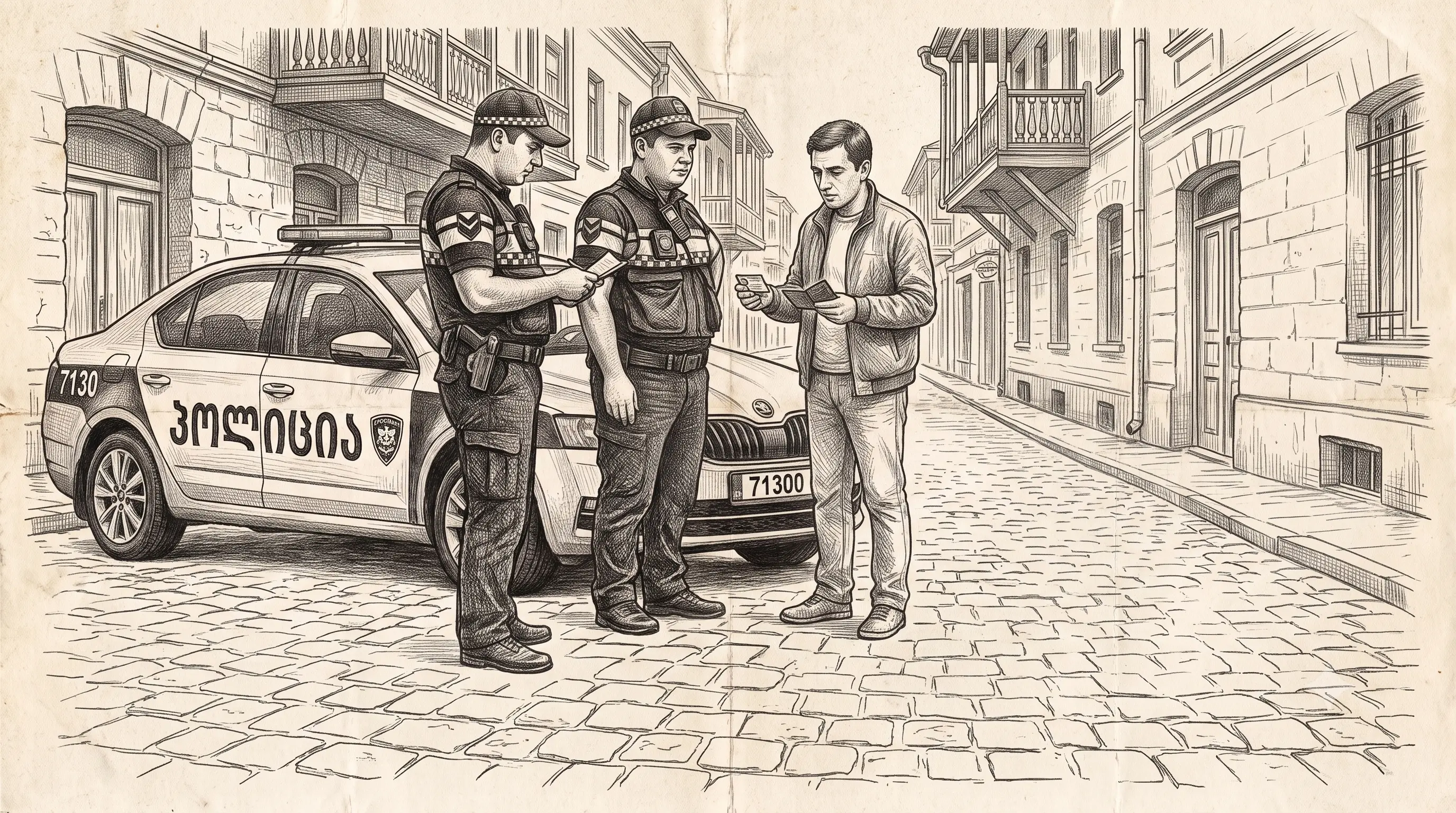
A basic action plan for an encounter with a Georgian patrol.
The bottom line, in two sentences
A street ID check is a routine preventive measure. If you stay calm and fulfil three simple obligations, by law the entire procedure cannot last longer than 30 minutes, and it ends with the officer letting you go.
What the police officer is entitled to do
A patrol can stop you on the street and ask for documents not "just because", but only on one of the grounds listed in Article 19 of the Law of Georgia "On Police". The main ones are:
- your appearance is similar to that of a wanted or missing person;
- there is sufficient reason to believe that you have committed or are about to commit an offence;
- you are on a territory or facility under a special regime, or in a place of special police control;
- you are at the scene of a crime, a traffic accident, or another emergency;
- your appearance, behaviour or vehicle indicates possible involvement in an offence.
If, in addition to checking documents, the officer intends to "pat" your clothes, this is a separate measure — the superficial check (Art. 22 of the Law "On Police"). It is permitted if the officer has sufficient reason to believe you carry a restricted or dangerous item, if you are within 20 metres of a special-regime facility, or if you are in a place where wanted persons may hide or where people illegally residing in Georgia gather.
Important: a superficial check means only running a hand or a special device over the surface of your clothing, plus a visual inspection of your bag or trunk (Art. 22, cl. 1 and 5). It is not a search. The moment the officer starts to open your bag, put a hand inside your pockets, or take out and rummage through the contents of your wallet, it becomes a search — which is governed by entirely different rules (the Criminal Procedure Code) and requires a warrant. This boundary is discussed in detail in a separate section below.
What you are obliged to do
By law, during a street check only three things are required of you:
- Stop and identify yourself — give your surname, first name and any personal details the officer asks for (Art. 19, cl. 1).
- Present an identity document — for a foreign national, this is a passport, ID card, residence permit or temporary certificate (including the certificate of a person under international protection). Always keep the document or a clear photo of it on you whenever you leave home.
- Allow a superficial check of your clothes if the officer states that a measure under Art. 22 is being applied. The check must be carried out by an officer of the same sex (in urgent cases — by any officer, but only using a device). If a bag or vehicle is inspected, the owner or a family member must be present.
That is all. The law requires nothing more of you.
What the police officer is obliged to do
- If they are not in uniform and cannot be identified as a police officer by external signs, they must show their service ID (Art. 18, cl. 3).
- State the grounds for the measure being applied — why exactly you were stopped — unless doing so would obstruct the police function (Art. 19, cl. 3).
- When conducting a superficial check, explain your right to appeal the lawfulness of the measure (Art. 22, cl. 7).
- Draft a protocol of the superficial check: who took part, in what circumstances, what was seized. You have the right to enter your comment into the protocol and attest it with your signature. If you refuse to sign, this is recorded in the protocol.
- Act proportionately: the police must terminate the measure as soon as its purpose is achieved (Art. 12).
What it actually looks like in practice
Everything above describes how the procedure should look under the law. In reality, patrols almost never unfold the full protocol on the street. It helps to know the actual scenario in advance so you don't get lost.
The officer will almost certainly not introduce themselves. The uniform and patrol car are treated as sufficient identification. If the officer is in plain clothes, asking to see the ID is your right (Art. 18 of the Law), but insisting on it aggressively is pointless.
You will most likely not be told the specific ground. The stock answer is "check", "for general safety", or "routine check". Legally this is not fully correct, but there is no point arguing about it on the street: the officer won't quote Article 19 by heart, and your arguing will only be treated as a reason to keep you longer. Just accept that the ground won't be explained, and move on to presenting your documents.
A protocol usually is not drawn up on the spot if nothing is found and you are released within 30 minutes. The protocol is the officer's obligation during a superficial check, but in practice it is drafted only when something is seized, recorded, or administrative proceedings begin. If they let you go without any papers, that is a good outcome, not a violation against you.
Patrols regularly cross over from an "inspection" into a search. They open bags, put hands inside, unzip wallets — without a warrant, without gloves, without witnesses. Formally, this is already a procedural violation (see the dedicated section below). In practice it happens literally every day; a calm "Please don't dig — I'll show you everything myself" often stops the escalation.
A translator will most likely be offered to you over the phone. A practising lawyer treats this as a procedural violation: an in-person translator should be physically present. It is better not to agree to the "phone translator" if you can wait a bit.
Reaching for the phone abruptly is a bad idea. Filming the police performing official duties in a public place is not prohibited under Georgian law (Constitution of Georgia, Art. 17 — freedom of information; no specific ban in the Law "On Police"). But the gesture of a stopped person immediately reaching into a pocket for the phone and pointing the camera into the officer's face is perceived as hostile: the typical reaction is annoyance, a demand to put the phone away, and a reason to keep you longer. The more sensible approach is either to openly warn, in an even tone, "I am starting an audio recording", or to reach for video only once the situation has already escalated: force is applied, you are held for longer than 30 minutes, they search your pockets, or demand you unlock the phone or hand over money.
Recording your own conversation: what the law says. An audio recording of a conversation you are yourself a party to, with a police officer performing official duties in a public place, does not fall under the prohibition of Art. 158 CC of Georgia ("unauthorised recording of private communications"): a conversation with an on-duty officer is not a private communication, and you are not an outside listener but a participant. The Law of Georgia "On Personal Data Protection" (2023), in Art. 2, cl. 2, subcl. "a", explicitly excludes from its scope processing of data by a natural person "for clearly personal purposes". There is no publicly known direct Supreme Court precedent on this point, so the safest option is an open recording with a prior warning. A covert recording is not directly criminalised, but remains in a legal grey zone. What is clearly prohibited is publishing or distributing the recording without the officer's consent: this is a separate offence under Art. 158, part 2, CC of Georgia (up to 5 years). A recording may be used only for your own defence: attached to a complaint to the Ombudsperson, handed to a lawyer, or given to an investigator.
Expect pressure and intimidation. Migrants are sometimes told "this is Georgia, our rules are not like in Russia / Ukraine / Belarus", "we can hold you for 60 days", "deportation is a single piece of paper". The intent is to make you nervous, start justifying yourself, show what you are not obliged to show, or agree to "settle it on the spot". These are pressure tactics, not legal procedure. In Georgia the law applies equally to citizens and foreigners (Art. 11 of the Law "On Police", the principle of non-discrimination). The rights of the person stopped do not depend on your citizenship.
Demands to "let me see your phone", "unlock it", "show me the messages" on the street are unlawful. This is no longer a superficial check. Inspection of a phone's contents is only possible under the CPC (a court warrant or urgent necessity with subsequent judicial confirmation). Calmly say: "I am not unlocking the phone. If you have grounds, process it under the CPC."
Your strategy: don't win the argument, just get through the check
If you have done nothing wrong and are carrying nothing forbidden, your goal is not to prove the officer wrong, but to end the episode quickly and without consequences. A simple internal setting works for this:
- I know that my obligation is to identify myself, present a document, and allow a hand across my clothes. Everything else falls under the CPC and requires either my informed consent or a court decision.
- I am not obliged to explain where I am going, what I am doing, or why I am here. Answering such questions is my right, not my duty (Art. 19, cl. 2: providing information during questioning is voluntary, save for special cases).
- I don't justify myself. Justifications sound like a sign of guilt and provoke "digging deeper".
- I am not rude, I don't argue about politics, I don't compare the Georgian police to the Russian one, I don't threaten with complaints.
- I keep a short, polite, matter-of-fact tone: "Hello. Here is my passport. Yes, of course. No, thank you." The less emotion, the shorter the check.
The experience of migrants and human rights defenders in 2024–2026 shows: a calm person with a document in hand who clearly understands the rules is the least interesting subject for a patrol. Such checks average 3–7 minutes, not 30.
The 30-minute rule
The key guarantee for the stopped person is set out in Art. 22, cl. 8 of the Law "On Police":
"The duration of the stop shall not exceed 30 minutes from the moment of the stop."
This means: from the minute you were stopped until the moment they must either let you go or move to a different procedure (detention, processing under the CPC, etc.), by law no more than half an hour may pass. If the document check and superficial inspection have revealed nothing within 30 minutes, you are free to go.
It's worth calmly noting the time yourself: glancing at your watch at the moment of the stop is your right, and it disciplines the situation.
If the officer starts to "identify" you
If you have presented a document but the officer doubts its authenticity or that it belongs to you, they may move to identification (Art. 20 of the Law "On Police"): fingerprints, photograph, checking data against the Ministry of Internal Affairs databases.
An important rule applies here: before such measures begin, you must be given a reasonable time to voluntarily confirm your identity (Art. 20, cl. 3). For example, by showing a second document, calling someone who can identify you, or showing a cloud-stored photo of your document. Use this right.
Inspection or search: the line you must not miss
This is the most common point where the procedure is quietly substituted in practice. The patrol announces a "superficial check" but in fact begins a full search — with hands inside pockets, opening bags, going through contents. By law these are two different procedures with different rules.
Superficial check (Art. 22 of the Law "On Police"):
- hand (or device) only over the surface of clothes;
- bags and trunk only visually, from the outside;
- no longer than 30 minutes;
- may be conducted without a warrant and without witnesses.
A search — this is already a measure under the Criminal Procedure Code of Georgia:
- a warrant is required (from a judge, or in urgent cases from the prosecutor with subsequent judicial confirmation);
- you must be familiarised with the warrant (if you don't understand — through a translator);
- the search is conducted on video;
- the officer conducting the search must be wearing gloves;
- attesting witnesses must be present — independent persons; using the translator as an attesting witness is improper;
- a protocol is drafted, recording all the actions;
- everything seized is placed in front of you into a sealed evidence bag; make sure it is closed so that the contents cannot fall out.
What to do when the officer crosses the line. If they open a bag and reach in with a hand, if they push fingers into your pocket, if they open a wallet — calmly say: "This is already a search. Show me the warrant." Until there is a warrant, offer to take things out yourself and show what you have: "Please don't dig — I'll show you everything myself." Such conduct has been documented as lawful in real practice and often makes the patrol stop. At the same time, describe out loud what you see: "You have no gloves", "There are no witnesses", "No warrant has been shown." If your audio recording is running, this documents the violations.
If the warrant is in fact presented. Do not sign it until you have read and understood it. If it is in Georgian and has not been translated to you — you are entitled not to sign and to demand a translator. In the comments field you may write in your own hand: "The warrant is in a language I do not understand, its contents have not been explained to me, I refuse to sign." The law permits this; the protocol/warrant is valid even without your signature, but your refusal and its reason are the most important argument later on appeal.
Your rights to a translator and a lawyer
If you do not speak Georgian, all paperwork must be carried out through a translator — this is a principle under the Constitution (the right to understand the procedures applied to you) and under the CPC. In practice, the police often try to bypass this rule.
On the translator:
- The translator must be in person, physically on the spot. Practising lawyers treat a "phone" or "online" translator as a procedural violation: you don't see their face, you can't be sure they are actually translating everything to you rather than just "sign here".
- If the translator translates poorly, skips parts, or rushes you, demand a replacement.
- You have the right to bring your own translator, if you have one available.
- It is reasonable to request the translator's certificate — that is part of checking their qualifications.
- Do not sign any document until the translation has been made word for word and you have understood the content. If a signature is nevertheless required, add the comment: "The text has not been translated to me / has been translated incompletely, the contents are unclear."
On the lawyer (Constitution of Georgia, Art. 13, cl. 4 — "A detained person shall have the right to demand the assistance of a defence counsel, and this demand shall be met"):
- The moment detention, protocol drafting, a search or a seizure comes up — demand a lawyer.
- The police may offer a state-appointed lawyer via the Legal Aid Service. By law they are obliged to arrive and represent you, but the real quality of defence varies.
- You are entitled to call your own private lawyer, one you trust. The police cannot refuse you a call to your own lawyer. If you do not have one but have a contact at a human rights organisation, call there.
- Until the lawyer arrives, sign nothing and do not speak on the substance beyond confirming your name.
Practical tip: save in advance in your phone and on a slip of paper (in your wallet) the number of one Georgian lawyer who speaks your language. 150 GEL for an urgent consultation is a standard price; but having the contact before the incident is many times more important than searching for it while you are being processed.
If something has been seized: silence is your best answer
If the police have found something and announce a seizure, a different rule of conduct kicks in at that moment. Up to that point the strategy was "calmly and politely present a document". From the moment of seizure, anything you say can be used against you.
- Do not explain where you got the item. Do not say where you bought it, who gave it to you, why you are carrying it, what you use it for. Even if the item is entirely yours and entirely legal, keep silent.
- Do not admit the item is yours, and do not dispute its ownership. Neither one nor the other. Simply: "All explanations will be given through a lawyer."
- Do not sign written explanations, confessions, or "consents to inspection given after the fact" — nothing.
- Demand a lawyer immediately. From this moment you are no longer a passing pedestrian; you are the subject of a case. All further actions — only through a lawyer.
- Watch the paperwork of the seized item. The bag must be sealed in front of you, and the bag number recorded in the protocol. Insist that the seized item be described in the protocol as precisely as possible: in what packaging, how many units, whether there is factory marking. If the officer writes "tablets", insist on adding "in a factory blister with the marking such-and-such". This often becomes decisive at expert examination and on appeal.
- Take your copy of the protocol, or at the very least photograph it or write down the number. If the protocol is "for internal use only", ask to be allowed to write down the number, the inspector's name, and the time; this should not be refused.
Remember: explanations on the spot don't help. No excuse spoken by a stressed person will make the officer return the seized item and let you go with an apology. A lawyer will then have to neutralise those explanations — sometimes unsuccessfully.
How to behave — practical points
- Keep your hands visible. Don't run, don't push the officer, don't reach into a bag or pocket without warning — first say: "I'm getting my passport out of the inner pocket."
- Speak calmly, don't switch to informal "you" and don't insult the officer. Since 2025, the CAO of Georgia has a separate provision on verbal insult of an official — up to 45 days of administrative arrest. Don't give a reason.
- Don't argue about the lawfulness of the measure on the street. Arguing on the spot won't cancel the check but may turn routine into conflict. All objections go into the protocol or into a later complaint.
- Don't justify yourself and don't tell more than necessary. You are not obliged to answer questions like "where are you going", "where did you come from", "where do you live" — this is questioning, and it is voluntary (Art. 19, cl. 2). A polite "I'd rather not answer" is enough.
- Don't fall for pressure. Phrases like "this isn't Russia for you", "we'll deport you within an hour", "you'll do 60 days" are psychological tactics. The rights of the person stopped do not depend on your citizenship (Art. 11 of the Law "On Police").
- Don't unlock your phone and don't show your messages. Inspection of a phone's contents on the street is beyond the scope of a superficial check; that requires CPC procedure.
- Don't reach for video as your first gesture. The safest option is an open audio recording: in an even tone say, "I am starting an audio recording." If you don't want to warn openly, a voice recorder in your pocket is not directly prohibited by law, but remains in a "grey zone" — use the recording only for your own defence and never publish it: distribution is a separate offence under Art. 158, part 2, CC of Georgia. Reach for video if the situation is already escalating: force is applied, you are held for longer than 30 minutes, they demand money or access to the phone.
- If you don't understand Georgian or English, say so immediately and ask to be made understood (a translator, an explanation in simple words). This is your right; the record must be intelligible to you.
- Don't sign a protocol blindly. Read what it says. If you disagree, add your comment in your own hand; the law expressly permits this (Art. 22, cl. 9). If the text is only in Georgian and you can't read it, write in the comments field: "The text is in a language I do not understand; its contents have not been explained to me."
- Keep the number of a lawyer you know in your phone. Having a contact before the incident is many times more important than searching for one at the moment of processing. A standard price for an urgent consultation is around 150 GEL, but for the lawyer to intervene in time you need the contact "right now".
- Record the officer's details. Full name, rank, badge / patrol car number, time and place. If a protocol is being drafted, ask for a copy or photograph your copy.
When it all ends
In a typical scenario: the officer approached — stated a ground — you showed your document — if needed a superficial check was carried out — a protocol was drafted — you were released. All this fits within the very same 30 minutes.
If it seemed to you that the measure was exceeded (for example, you were held for more than 30 minutes, told to remove clothes without grounds, or force was applied), do not go to complain to the police or the prosecutor's office on your own. In 2025–2026, human rights defenders and the Council of Europe are recording a high risk of counter-charges ("disobedience" — Art. 173 CAO, "petty hooliganism" — Art. 166 CAO) and subsequent expulsion from the country.
The safe first step is to call the hotline of the Public Defender (Ombudsperson) of Georgia: 1481 (24/7). They will record the fact of the violation, and it will become the basis of a future complaint. If they try to place you under administrative detention, immediately request a free state lawyer through the Legal Aid Service: 1485.
Appealing a protocol or a warrant can be filed in two ways: online through the Public Service Hall services (my.gov.ge) or physically — at the Public Service Hall (the "glass wave" building on Kakheti Highway in Tbilisi). Online is simpler and faster. The appeal deadlines depend on the type of document (administrative protocol, inspection warrant, arrest decision), and there are nuances — for a specific document it is better to check with a lawyer. In any case: the earlier the complaint is filed, the stronger it hits the entire chain of police actions; sometimes a single properly filed appeal knocks the whole case out.
Short "police stopped me" checklist
- Stop. Keep your hands visible. Speak your movements out loud ("I'm getting my passport").
- Say hello calmly. If you wish, warn evenly: "I am starting an audio recording." (A covert recording is not directly prohibited by law, but it must not be published.)
- State your name, show your passport / residence permit / ID. More — as circumstances require, but don't justify yourself.
- If a superficial check is announced, don't resist; the checking officer must be of your sex, hand only over the clothes.
- If the officer puts a hand into a bag or a pocket: "This is already a search. Show me the warrant." Until there is a warrant: "I will show you everything myself."
- During a search, check: the warrant, gloves, attesting witnesses (not the translator!), video recording, evidence bag sealed in front of you.
- Don't unlock your phone. You are not obliged to answer "where are you going".
- Note the time. Remember the 30-minute rule.
- Don't react to pressure and intimidation ("we have different laws here") — briefly, politely, to the point.
- Translator — in person only. Refuse the phone translator. Do not sign anything until translation has been made word for word.
- If something has been seized, keep silent. Explain nothing, demand your own lawyer. In the protocol — a precise description of the seized item (packaging, marking).
- If a protocol is being drafted — read it, and if you disagree, add a comment in your own hand.
- Record the officer's full name and number, and the protocol number. If force starts or you are held for longer than 30 minutes, reach for video.
- If something went wrong, don't argue on the spot. Call the Ombudsperson: 1481. In case of detention — Legal Aid Service: 1485.
Sources
All links go to the "Legislative Herald of Georgia" (matsne.gov.ge), the official state portal for the publication of normative acts.
The Constitution of Georgia — Art. 13 (personal freedom, guarantees on detention):
- document page: matsne.gov.ge/en/document/view/30346
The Law of Georgia "On Police" (2013, doc_id 2047533) — Art. 8 (principles), Art. 12 (proportionality), Art. 18 (preventive measures and the duty to show ID), Art. 19 (questioning of a person and grounds for checking documents), Art. 20 (identification of a person), Art. 22 (superficial check and the 30-minute rule):
- document page: matsne.gov.ge/en/document/view/2047533
- PDF in English: matsne.gov.ge/en/document/download/2047533/26/en/pdf
The Code of Administrative Offences of Georgia (CAO) — Art. 166 ("petty hooliganism"), Art. 173 ("disobedience to a lawful demand of a police officer"), and the provision on verbal insult of an official (introduced in 2025):
- document page: matsne.gov.ge/ka/document/view/28216
The Criminal Procedure Code of Georgia — search procedure (applies when a superficial check turns into a full search):
- document page: matsne.gov.ge/en/document/view/90034
The Criminal Code of Georgia — Art. 158 (violation of the secrecy of private communication: both recording and, separately, distribution of the recording):
- document page: matsne.gov.ge/en/document/view/16426
The Law of Georgia "On Personal Data Protection" (2023, doc_id 5827307) — Art. 2 (exception for personal purposes), Art. 11 (audio monitoring with prior notice — refers to installed systems, not to a participant of a conversation):
- document page: matsne.gov.ge/en/document/view/1561437
The Public Defender (Ombudsperson) of Georgia — receives complaints against police:
- website: ombudsman.ge
- 24/7 hotline: 1481
The Legal Aid Service of Georgia — state-appointed free defence counsel in case of administrative detention:
- website: legalaid.ge
- hotline: 1485
Only the Georgian original of a law has legal force. The English translation on matsne.gov.ge lags one publication behind the Georgian version — for the 30-minute stop rule and the police officer's duties this discrepancy is immaterial; for disputed wording, verify against the Georgian PDF original.
Related questions
- Is a photo of my passport on the phone enough, or do I need the original?
- Am I obliged to explain where I am going, where I live, and what I am doing?
- The officer told me not to film — do I have to comply?
- My prescription medication was seized. What happens now, and can I get it back?
- How do I quickly find an English-speaking lawyer in Tbilisi?
- Can I refuse to go to the station if I am being 'invited'?